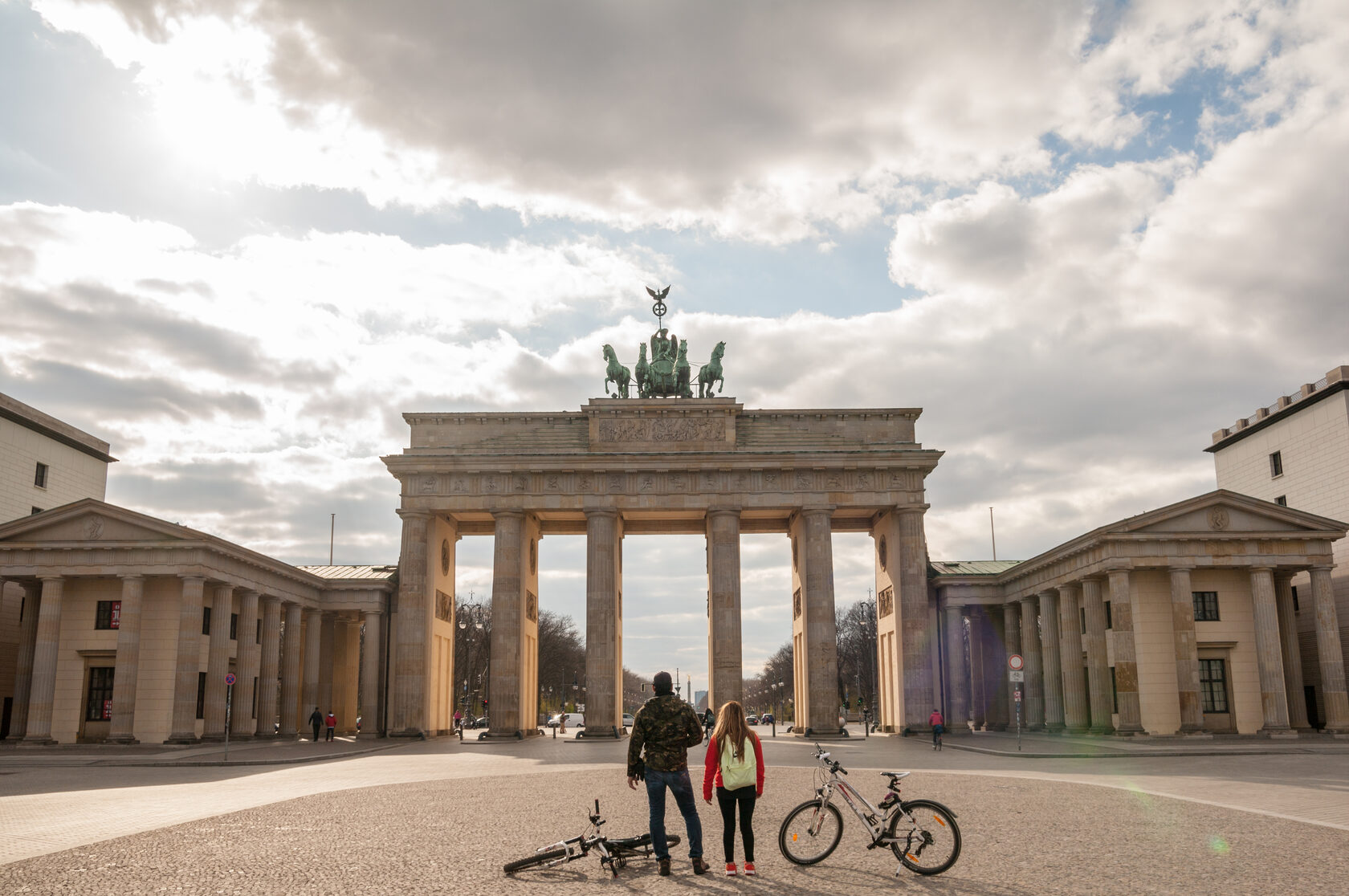
Today, it’s the ultimate postcard image of Germany, but the Brandenburg Gate started its life as a completely ordinary checkpoint. In the 18th century, it was just one of 18 gates built into Berlin’s customs wall, meant for collecting taxes on flour and beer.
While the other 17 gates vanished long ago — surviving only as U-Bahn stops on the Berlin city map (like Kottbusser Tor or Schlesisches Tor) — the Brandenburg Gate made it into the history books.
We have King Frederick William II to thank for that. He wanted a grand entrance at the edge of his royal Tiergarten hunting grounds to honor his legendary uncle, Frederick the Great. He hired architect Carl Gotthard Langhans, who took a basic toll booth with a wooden barrier and transformed it into a massive sandstone monument inspired by the Propylaea of the Athenian Acropolis. The walls were covered in reliefs of the labors of Hercules, and the whole thing was crowned by a spectacular Quadriga — a chariot pulled by four horses and driven by the Roman goddess of victory, designed to show off Prussian military might.
When the Prussian army eventually helped crush Napoleon, the gate officially turned into a symbol of military triumph. That status is exactly why it was saved from the wrecking ball when the rest of the old city walls were torn down in the 1860s. Unfortunately, that same grand, nationalistic vibe made it a magnet for Nazi propaganda marches decades later.
The darkest chapter for this Berlin landmark came during the Cold War. When the Berlin Wall went up in 1961, the gate was trapped right in the middle of the "death strip," completely inaccessible to both East and West Berliners. For nearly thirty years, people in the East could only stare at it from behind barricades.
However, because the wall directly in front of the gate was built lower and wider than in other parts of the city, it became the stage for the historical night in November 1989. When the borders opened, hundreds of people climbed up and danced on top of the wall right in front of the gate, creating some of the most iconic press photos of the 20th century.
After centuries of being claimed by emperors, dictators, and occupying forces, the Brandenburg Gate has finally shed its wartime past. Today, it stands as the definitive symbol of German reunification, peace, and open borders.
To experience Berlin to the full, this private historical tour with B LONG!
